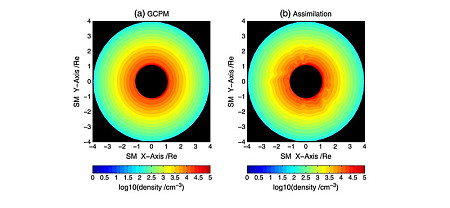
AbstractIncreasing total electron content (TEC) measurements from the low Earth orbiting satellites to Global Positioning System satellites flourish the exploration of the ionosphere and plasmasphere for decades. This paper indicates a method that 3‐D Var is applied to assimilate precise orbit determination antenna TEC measurements of Constellation Observing System for Meteorology, Ionosphere, and Climate (COSMIC) satellites into the background global core plasma model (GCPM). The slant TEC data archived in the COSMIC Data Analysis and Archive Center from 500 km to 20,200 km are used to reconstruct a new electron density model. This model has a temporal resolution of 2 h and spatial resolutions of 2.5° in geomagnetic latitude, 5° in longitude, 50 km in the upper ionosphere, and several hundred kilometers in the plasmasphere. Preliminary results show that the data assimilation modifies the initial GCPM forecast to be better coincident with actual COSMIC measurements in internal quality check. Furthermore, independent validation with upper ionosphere‐retrieved electron density and TEC of global ionosphere maps implies a reasonable improvement in the estimation of plasmaspheric electron density after the assimilation. DOI: 10.1002/2015RS005732 https://agupubs.onlinelibrary.wiley.com/doi/full/10.1002/2015RS005732
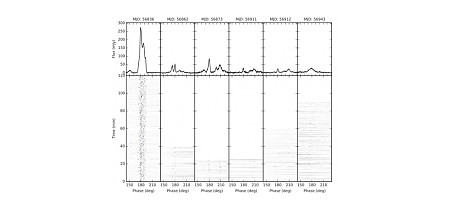
AbstractIn this paper, we report radio observations of the Galactic Center magnetar PSR J1745-2900 at six epochs between 2014 June and October. These observations were carried out using the new Shanghai Tian Ma Radio Telescope at a frequency of 8.6 GHz. Both the flux density and integrated profile of PSR J1745-2900 show dramatic changes from epoch to epoch, showing that the pulsar was in its “erratic” phase. On MJD 56836, the flux density of this magnetar was about 8.7 mJy, which was 10 times larger than that reported at the time of discovery, enabling a single-pulse analysis. The emission is dominated by narrow “spiky” pulses that follow a log-normal distribution in peak flux density. From 1913 pulses, we detected 53 pulses whose peak flux densities are 10 times greater than that of the integrated profile. They are concentrated in pulse phase at the peaks of the integrated profile. The pulse widths at the 50% level of these bright pulses were between 0.°2 and 0.°9, much narrower than that of the integrated profile (∼12°). The observed pulse widths may be limited by interstellar scattering. No clear correlation was found between the widths and peak flux density of these pulses and no evidence was found for subpulse drifting. Relatively strong spiky pulses are also detected in the other five epochs of observation, showing the same properties as those detected in MJD 56836. These strong spiky pulses cannot be classified as “giant” pulses but are more closely related to normal pulse emission. DOI: 10.1088/0004-637X/814/1/5https://arxiv.org/pdf/1510.00183.pdf




 Standard
Login
Standard
Login SEP Login