



The International Conference on Fundamental Physics from Quanta to Cosmos 2026 (ICFP 2026) took place in Beijing from October 24 to 26. Co-organisers include the Centre for Gravitational Wave Physics and Cosmology, Institute of Theoretical Physics, Chinese Academy of Sciences; the International Centre for Theoretical Physics Asia-Pacific, University of Chinese Academy of Sciences; and the School of Fundamental Physics and Mathematical Sciences, Hangzhou Institute for Advanced Study, UCAS. More than 150 experts and scholars from 13 countries gathered to conduct in-depth exchanges and discussions on frontier issues in fundamental physics, ranging from the smallest elementary particles to the vast cosmos, with the aim of fostering broader and deeper international collaboration.

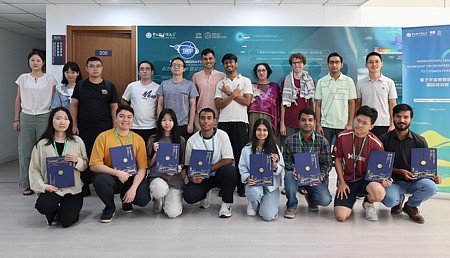
ICFP 2026 Group photo

Group photo of participants
The opening ceremony was presided over by Researcher Zhou Yufeng, Deputy Director of the Institute of Theoretical Physics. Academician Wu Yueliang delivered the welcome address. He warmly welcomed all domestic and international participants. He noted that interdisciplinary integration in fundamental physics is growing increasingly robust. As a key platform for international academic exchange, ICFP brings together the latest research advances and continuously promotes the integration of theory and experiment. Thanks to the rapid development of China’s major scientific facilities, fundamental physics research in China has entered a new stage where the country is capable of leading high-level studies and gaining greater say in global academic exchanges. China holds competitive advantages especially in neutrino physics, space-based gravitational waves, dark matter and related fields. Looking ahead, artificial intelligence is poised to empower fundamental physics research and may enable major breakthroughs.

Yufeng Zhou presiding over the opening ceremony

Yue-Liang Wu delivering the address
The conference consisted of plenary talks, parallel session presentations and panel discussions. For plenary talks, 27 scholars from domestic and overseas universities and research institutions gave presentations, including Academician Tipei Li (Institute of High Energy Physics, CAS), Academician Zuotang Liang (Shandong University), Prof. Mairi Sakellariadou (King's College London), Prof. Jun'ichi Yokoyama (The University of Tokyo), Prof. Pyungwon Ko (Korea Institute for Advanced Study), and Prof. Remo Ruffini (International Centre for Relativistic Astrophysics Network). Their presentations covered the latest progress of major Chinese scientific facilities and international collaborations, such as the China-led dark matter detection collaborations, China Jinping Underground Laboratory, Large High Altitude Air Shower Observatory, Taiji Program, Tianqin Program, Jiangmen Underground Neutrino Observatory, and Beijing Spectrometer III, as well as frontier achievements in gravitational waves, dark matter, inflationary cosmology and primordial perturbations.
Three parallel sessions were arranged, focusing respectively on gravitational wave physics, particle phenomenology, and gravity and cosmology. Scholars from home and abroad delivered a total of 34 presentations to share and discuss cutting-edge progress in these areas.
During the panel discussion, participants systematically reviewed the three-day agenda and engaged in lively deliberations on frontier topics and avenues for future cooperation. Meanwhile, the editorial office of the Institute of Theoretical Physics introduced the journal Theoretical Physics and its new sister publication Theoretical Physics Letters. It was agreed that the next edition of the conference will be hosted by the Hangzhou Institute for Advanced Study, UCAS.


During the conference, some domestic and international experts visited the History Museum, Library, Sino-Danish College and Science & Art Building on the Yanqihu Campus of UCAS to learn about the university's history and educational achievements on site.

Visit photos
Initiated by the Institute of Theoretical Physics in 2001, this conference series has gone through three developmental phases. It was originally named the International Conference on Flavour Physics (ICFP). The inaugural meeting was held in Zhangjiajie, Hunan Province, China, serving as an important academic exchange venue within the high-energy physics community.
In its second phase, the conference was renamed the International Conference on Flavour Physics and Cosmology when it was held in Weihai in 2012. The name change expanded its disciplinary scope to cover major fundamental science questions including the origin of fermion masses, flavour mixing, CP violation, lepton physics and hadron physics. Closely aligned with large experimental facilities such as B-factories, neutrino experiments and the Large Hadron Collider (LHC), it effectively boosted cross-fertilisation between theoretical and experimental research and facilitated substantive research cooperation between China and the rest of the world.
To adapt to the trend of interdisciplinary development in fundamental physics, starting with this 2026 Beijing meeting, the series has officially adopted its new name: the International Conference on Fundamental Physics from Quanta to Cosmos (ICFP 2026).


 Standard
Login
 SEP Login