




A new study by the LIGO, Virgo, and KAGRA (LVK) collaborations has used ground-based gravitational-wave detectors to search directly for ultralight dark matter and test possible modifications to gravity. The study was recently published online in *Physical Review Letters*. The research was led by **Andrew L. Miller**, Associate Professor at the International Centre for Theoretical Physics Asia-Pacific (ICTP-AP), University of Chinese Academy of Sciences (UCAS). The study employed three independent search pipelines: **BSD excess-power**, led by Andrew L. Miller; **cross-correlation**, led by Associate Professor Huaike Guo of ICTP-AP and Associate Professor Yue Zhao of the Hong Kong University of Science and Technology; and **Logarithmic Power Spectral Density (LPSD)**, led by Dr. Alexandre S. Göttel of Cardiff University, UK. Other key contributors included Dr. Mai Qiao, a postdoctoral researcher at ICTP-AP, as well as researchers from Peking University, the University of Michigan, the University of Florida, the University of California, Davis, the University of Illinois, and Phenikaa University in Vietnam.
The research team analyzed data collected during the first part of the fourth observing run (O4a, from May 24, 2023, to January 16, 2024, UTC), searching for three possible forms of ultralight dark matter: scalar dark matter known as **dilatons**, vector **dark photons**, and **tensor bosons**.
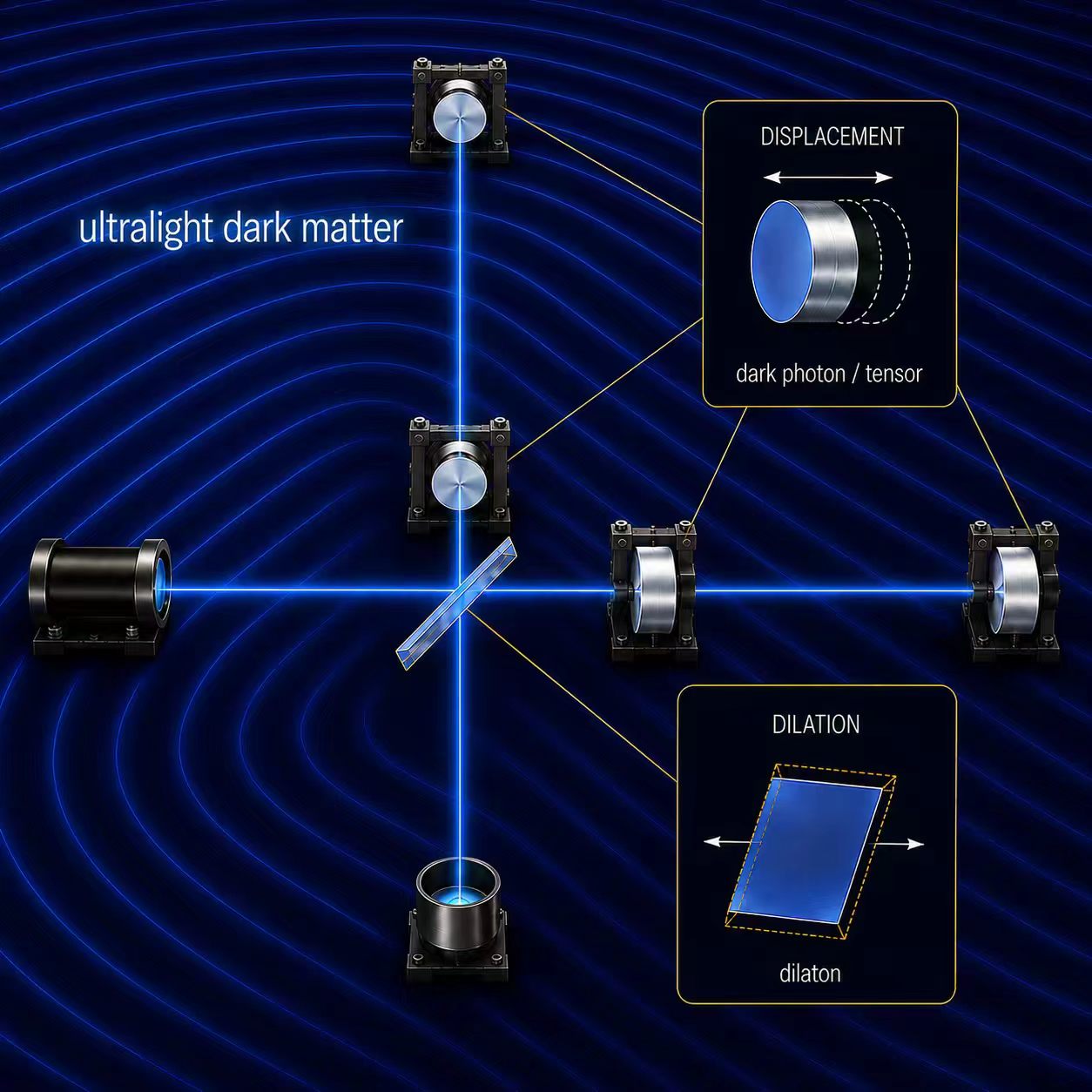
Although no evidence for dark matter was found, the researchers placed some of the most stringent constraints to date on how these particles could interact with ordinary matter and gravitational-wave interferometers. For dilaton dark matter, the new constraints are approximately one order of magnitude stronger than those obtained in previous gravitational-wave searches. For dark photons, the constraints surpass those from high-precision tests of the equivalence principle, such as MICROSCOPE and Eöt-Wash, by one to two orders of magnitude over part of the mass range. Most notably, the study presents the **first constraints on tensor bosons obtained using gravitational-wave interferometers**, improving upon previous fifth-force experimental constraints by as much as **five orders of magnitude**. Such tensor fields arise in a broad range of modified theories of gravity. These results therefore demonstrate that precision detectors originally designed to observe gravitational waves can not only search for dark matter but also serve as powerful tools for testing modified theories of gravity, opening new avenues for exploring fundamental physics beyond our current understanding of gravity.
This research was supported by grants from the **National Natural Science Foundation of China** and special research programs of the **Chinese Academy of Sciences**.
Publication link: https://journals.aps.org/prl/abstract/10.1103/qdnd-rsnh

 Standard
Login
Standard
Login SEP Login