




Recently, good news arrived from the editorial office of Scientia Sinica Physica, Mechanica & Astronomica (SSPMA): a review paper titled "Challenges in Space Gravitational Wave Detection Science Data Processing and the Application of Artificial Intelligence Technology (空间引力波探测科学数据处理的挑战与人工智能技术的应用)," authored by Research Associate He Wang from the International Centre for Theoretical Physics Asia-Pacific (ICTP-AP) at the University of Chinese Academy of Sciences, along with collaborators Associate Professor Minghui Du and Professor Peng Xu from the Institute of Mechanics, Chinese Academy of Sciences (CAS), and Professor Yufeng Zhou from the Institute of Theoretical Physics, CAS, has won the journal's 2025 Outstanding Paper Award.
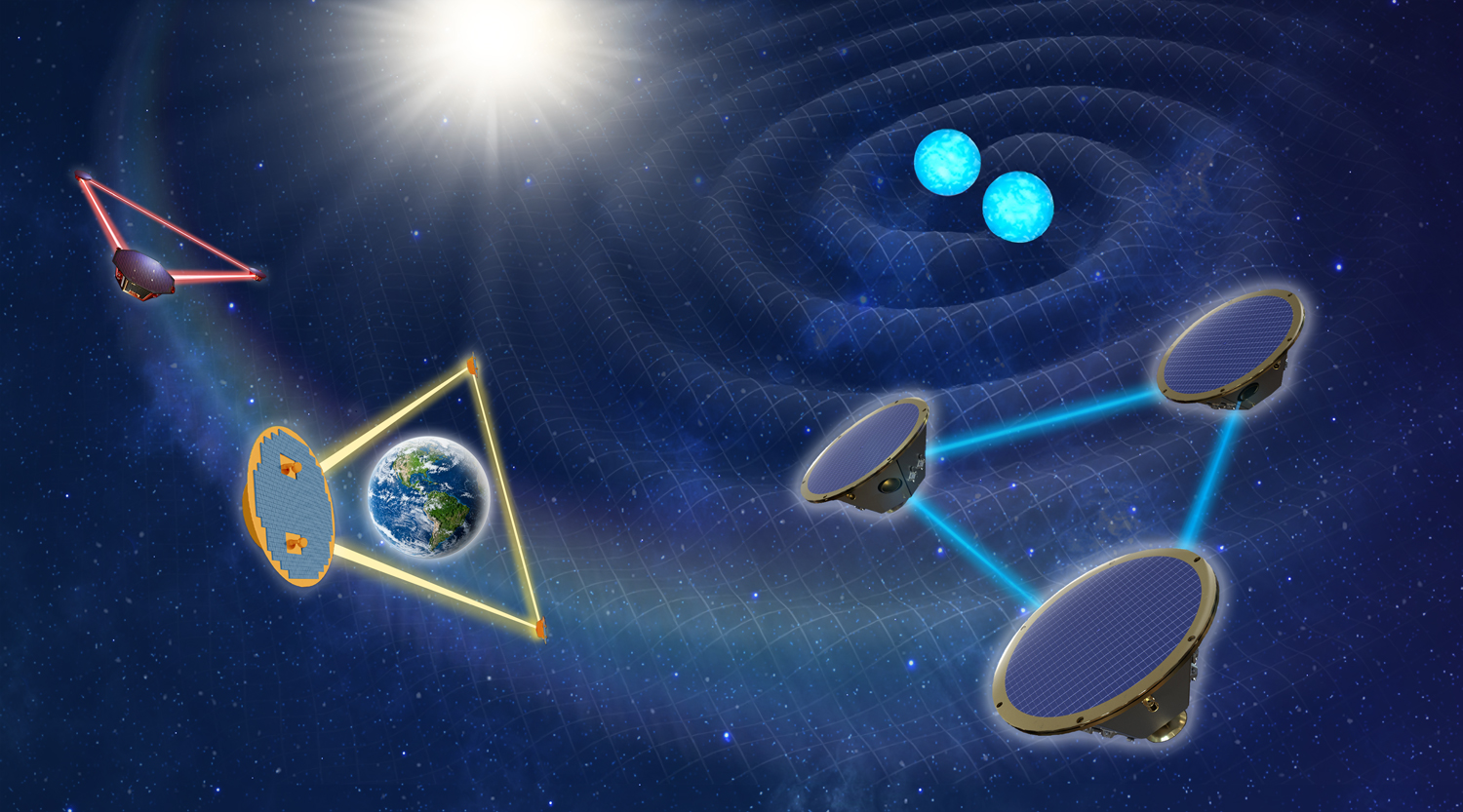
The paper was published in SSPMA, Vol. 54, No. 7, 2024 (Article No.: 270403). Against the backdrop of space gravitational wave detection projects such as LISA, Taiji, and TianQin being poised to bring an entirely new perspective on observing the universe, the paper systematically reviews the unprecedented challenges faced in data processing for space gravitational wave detection. Using the Bayesian statistical inference framework as a thread, the paper provides an in-depth review of the entire process—from waveform template construction and detector response simulation to noise and data anomaly handling—and focuses on technical strategies for global fitting and parameter inversion, particularly the construction and computation of likelihood functions.
Of particular importance, the paper highlights cutting-edge applications of artificial intelligence technology in gravitational wave signal modeling, noise and data anomaly handling, signal identification, and parameter estimation. The paper points out that in the face of challenges such as the massive superposition of signals, non-stationary noise, and data anomalies in space gravitational wave detection, artificial intelligence technology—especially deep learning and GPU-accelerated computing—is expected to become a key tool for data processing, providing new pathways and tools for solving complex problems and demonstrating its unique advantages in accuracy, efficiency, and generalization.
SSPMA’s Outstanding Paper Award
SSPMA (Chinese edition) and SCIENCE CHINA Physics, Mechanics & Astronomy (SCPMA, English edition) are both supervised by the Chinese Academy of Sciences and co-sponsored by the Chinese Academy of Sciences and the National Natural Science Foundation of China. The Outstanding Paper Awards for both journals are organized and evaluated uniformly by the editorial board and announced together under the framework of "Outstanding Papers of the Chinese and English Editions." The selection is rigorously made from papers published in the past two years, and the number of awards for the Chinese edition is usually quite small—for example, in 2024, a total of 20 papers received the award, of which only 5 were from the Chinese edition.
SSPMA is indexed by two major international databases, ESCI and Scopus, as well as by authoritative domestic indexes such as A Guide to the Core Journals of China and the Chinese Science Citation Database (CSCD). It is a benchmark publication in the Chinese scientific research ecosystem that combines international visibility with local influence. Its annual best paper award has rigorous evaluation criteria, and award-winning papers typically represent high-level, influential research in their fields.

 Standard
Login
Standard
Login SEP Login