




The exploration of extra dimensions and quantum gravity has long been a frontier of theoretical physics. Recently, Associate Professor Jun Nian and student of the International Centre for Theoretical Physics Asia-Pacific (ICTP-AP) at the University of Chinese Academy of Sciences published a paper in the journal Physical Review D systematically investigating the correction effects of quantum fluctuations near the horizon of near-extremal black branes on the Randall–Sundrum (RS) warped braneworld model.
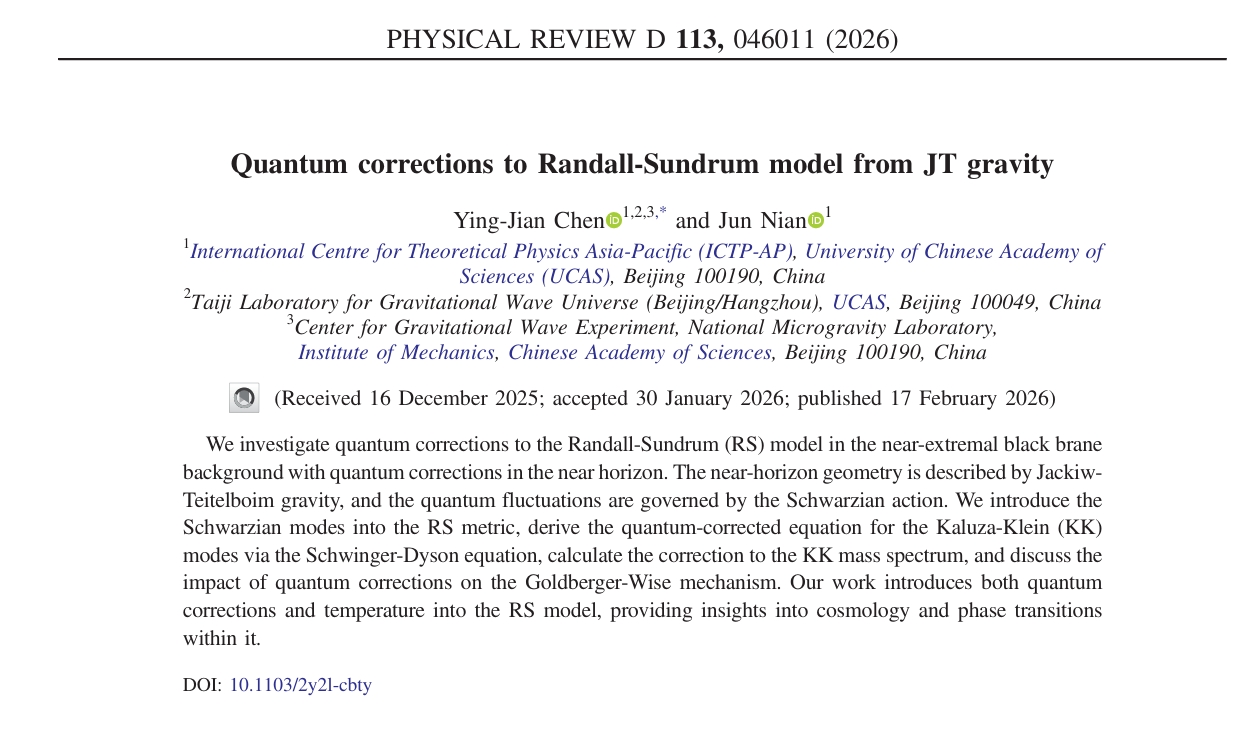
The RS model introduces a warped extra dimension to provide an elegant geometric framework for addressing the hierarchy problem. However, its classical construction does not incorporate quantum gravitational effects or temperature degrees of freedom, which limits its applicability to dynamical processes such as early-universe phase transitions. Over the past decade, Jackiw–Teitelboim (JT) gravity and its boundary Schwarzian mode have proven effective in describing near-horizon quantum fluctuations of near-extremal black holes, offering a natural tool to overcome the above limitation. The present work introduces this technique into the RS model by implanting the Schwarzian mode into the near-horizon geometry of the black brane and deriving the quantum-corrected equations of motion via the Schwinger–Dyson equations, thus achieving a temperature-dependent quantization of the warped compactification background.
Within this corrected framework, the team re-calculates the Kaluza–Klein (KK) graviton mass spectrum. They find that the eigenvalues acquire a universal temperature-dependent factor relative to the original classical results. When higher-order corrections are included, the mass corrections for different KK modes show a trend of increasing with the energy level, and the signs of the low-order and higher-order corrections are opposite, suggesting the potential importance of non-perturbative effects. Meanwhile, the study also examines the impact of quantum corrections on the Goldberger–Wise (GW) modulus stabilization mechanism, finding that it is merely equivalent to a renormalization of the GW scalar field mass and does not destabilize the stabilization condition, thereby ensuring the robustness of the RS model’s self-consistency. These results demonstrate that infrared quantum gravitational effects can be incorporated into warped extra-dimensional theories in a controllable manner, and provide new theoretical tools for future studies of brane phase transitions and gravitational wave signals at finite temperature.
This work was supported by the International Partnership Program of the Chinese Academy of Sciences (Grant No. 025GJHZ2023106GC) and the National Natural Science Foundation of China (Grants No. 12375067, No. 12147103, and No. 12247103). The research was completed by Ph.D. student Ying-Jian Chen at ICTP AP under the supervision of Associate Professor Jun Nian.
Article link:
https://doi.org/10.1103/2y2l-cbty


 Standard
Login
Standard
Login SEP Login